Best UPI Payment Gateway for Local and Small Business in India
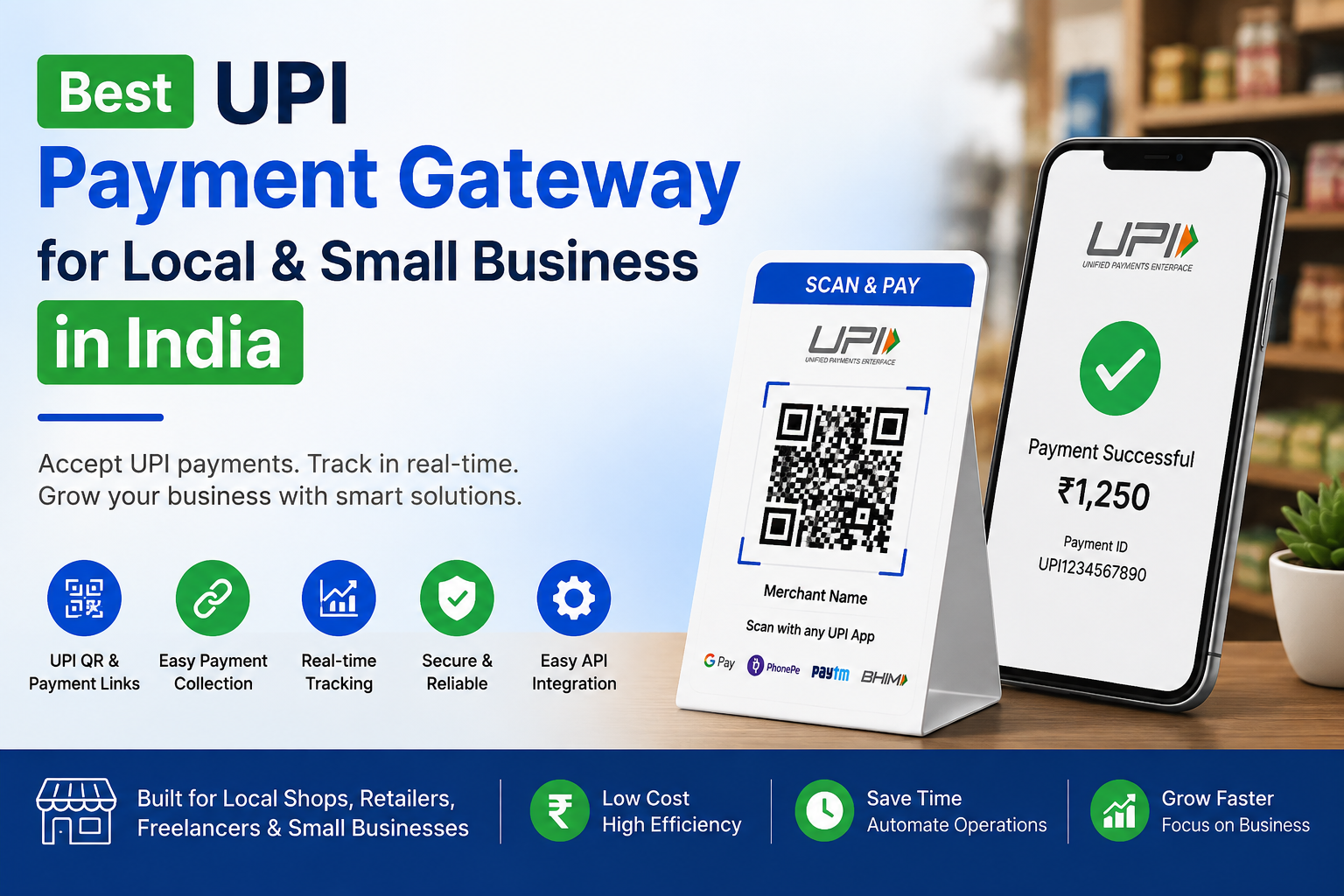
For local shops and small businesses in India, the best UPI payment gateway is one that makes collecting payments simple while providing reliable transaction tracking, payment status updates, and easy integration. Businesses should compare factors such as transaction flow, settlement process, payment links, QR options, API support, reporting, security, and overall ease of use before choosing a provider.
What Should a Small Business Look for in a UPI Payment Gateway?
A small business should choose a payment gateway based on how easily it can accept, track, and manage customer payments. A low-cost solution is useful, but reliability and clear transaction records matter just as much.
Local businesses often have different needs from large e-commerce companies. A neighborhood retailer may primarily need QR-based collections, while an online service provider may need payment links and website integration.
Before choosing a provider, consider these factors:
Easy UPI payment collection
Dynamic or static QR payment options
Payment links for remote customers
Clear transaction status
Settlement and reconciliation features
Payment reports and transaction history
API and webhook support
Website or app integration
Security features
Responsive customer support
Transparent pricing and applicable charges
The right choice depends on the business model. There is no universal “best” gateway for every merchant.
Why Is UPI Payment Gateway Important for Local Businesses?
A UPI payment gateway helps businesses move beyond simply displaying a QR code by adding a more structured payment process. It can connect payment collection with websites, applications, orders, invoices, and transaction records.
For a local business, this can be particularly useful when customers pay remotely or when the owner needs to confirm a
transaction without manually checking every payment.
For example, imagine a small service business receiving dozens of UPI payments in a day. Checking each transaction manually and matching it with an order can quickly become tedious. A properly designed payment system can make this process much easier.
A UPI payment gateway for local business should therefore focus on simplicity first. The merchant should not need a technical degree to understand whether an order has been paid.
How Does a UPI Payment Gateway Help Small Businesses?
A UPI payment gateway for small business can simplify several parts of the payment process, from collection to transaction tracking.
Some common benefits include:
Easier payment collection
Customers can pay using familiar UPI applications instead of relying only on cash or card payments.
Better transaction visibility
Digital records make it easier to identify successful, failed, or pending transactions.
Remote payment collection
Payment links can help businesses collect payments from customers who are not physically present at the shop.
Easier reconciliation
Reconciliation means matching received payments with orders, invoices, or customer records. Automation can reduce the amount of manual checking involved.
Better customer experience
A clear payment flow reduces confusion during checkout. Customers want to pay and move on—not participate in a detective investigation about whether their payment went through.
UPI Payment Gateway vs Direct QR: What Is the Difference?
A basic QR code and a payment gateway are not the same thing. A QR code primarily provides a way for customers to initiate a UPI payment, while a gateway can provide a broader payment workflow and transaction management layer.
| Feature | Basic UPI QR | UPI Payment Gateway |
|---|---|---|
| UPI payment acceptance | Yes | Yes |
| Customer payment initiation | Yes | Yes |
| Transaction tracking | Limited depending on setup | More structured |
| Website integration | Usually limited | Available with supported APIs |
| Payment links | Usually not a core feature | Often supported |
| Automated status updates | Limited | Can be supported |
| Webhooks | Generally unavailable | Available with API-based systems |
| Order-payment matching | Limited | Can be automated |
| Payment reporting | Basic/provider dependent | More detailed depending on provider |
For a small physical shop that only needs simple payments, a QR may be enough. Businesses that sell online, manage orders, or need automated tracking may benefit from a more complete payment solution.
What Is the Best UPI Payment Solution for Small Business?
The best UPI payment solution for small business depends on the merchant's payment workflow rather than simply the provider's brand name.
A retailer with a physical store may prioritize QR payments and simple transaction records. An online seller may care more about payment links, checkout integration, APIs, webhooks, and automated order updates.
A practical selection process looks like this:
Identify how customers pay.
Determine whether payments happen in-store, through a website, through payment links, or through multiple channels.
Check integration requirements.
If the business has a website or application, check whether the payment platform provides suitable APIs or integration options.
Review transaction tracking.
Make sure the system clearly distinguishes successful, pending, failed, and other transaction states.
Understand settlements and reconciliation.
Check how payment records can be reviewed and matched with business transactions.
Compare pricing carefully.
Look beyond the headline rate and review applicable transaction fees, platform charges, taxes, and other conditions.
Evaluate support and documentation.
Technical documentation matters for online businesses, while responsive support may matter more for a small merchant without a technical team.
How Can Small Businesses Use UPI Payment Collection?
UPI payment collection for small business can work across both physical and online operations.
A local retailer can use QR-based payments at the point of sale. A consultant can send a payment link after completing a service. An online seller can integrate UPI payments into its checkout process.
Businesses can also use payment records to maintain better internal accounts.
Common use cases include:
Retail stores
Restaurants and cafés
Freelancers
Local service providers
Tuition and coaching businesses
Small online stores
Home-based businesses
Repair and maintenance services
Professional consultants
Subscription-based services
The important part is choosing a payment flow that matches the way customers actually buy.
What Makes an Online Payment Gateway Useful for Small Businesses in India?
An online payment gateway for small business India should do more than accept payments. It should help the business understand what happened after the customer clicked “Pay.”
For online businesses, useful capabilities can include payment links, checkout integration, transaction status notifications, APIs, webhooks, reports, and reconciliation tools.
Payment links
Payment links are useful when a business needs to request payment without building a complete online checkout system.
APIs
An API allows different software systems to communicate. For example, an online store can connect its order system with a payment platform.
Webhooks
A webhook can send an automatic notification when an event occurs, such as a payment status changing. This can help an application update an order without repeatedly checking the payment system.
Transaction reporting
Reports help merchants review payment activity and identify discrepancies.
These features become increasingly useful as a business grows.
How Can a Business Choose the Best Digital Payment Solution?
The best digital payment solution for small business should balance usability, reliability, features, and cost.
A useful comparison checklist is:
| Factor | What to Check |
|---|---|
| Payment methods | UPI and other supported options |
| QR support | Static or dynamic QR capabilities |
| Payment links | Availability and flexibility |
| Integration | Website, app, API options |
| Webhooks | Real-time event notifications |
| Reporting | Transaction history and reports |
| Reconciliation | Tools for matching payments |
| Security | Secure payment and data handling |
| Pricing | Applicable fees and taxes |
| Support | Documentation and customer assistance |
| Scalability | Ability to support business growth |
Do not select a provider solely because it has the lowest advertised price. A slightly more capable system can save substantial manual work when payment volume increases.
Why Payment Automation Matters as a Business Grows
Payment automation becomes more valuable when the number of daily transactions increases.
A business receiving five payments a day may manage them manually without much trouble. A business receiving hundreds of transactions has a different problem. Searching through payment records and matching every transaction manually takes time and creates opportunities for mistakes.
Automation can help with tasks such as:
Payment status updates
Order confirmation
Transaction notifications
Payment reconciliation
Reporting
Customer payment tracking
This is where modern payment infrastructure becomes more useful than a simple payment collection method.
Is UPIPE Suitable for Small and Local Businesses?
UPIPE is designed around UPI payment collection and payment infrastructure, with capabilities aimed at helping businesses manage payment flows, transaction information, and integrations.
For a small or local business, the important question is not simply whether a platform accepts UPI. The better question is whether its features fit the business's actual workflow.
A merchant considering UPIPE should review its available payment options, integration capabilities, transaction handling, documentation, pricing, and support before making a final decision.
What Are the Common Mistakes When Choosing a Payment Gateway?
Small businesses often focus too heavily on price and overlook the day-to-day payment experience.
Common mistakes include:
Choosing a provider without checking integration requirements
Ignoring payment failure and pending-status handling
Not reviewing settlement terms
Selecting a system that becomes difficult to manage as transactions grow
Overlooking transaction reporting
Failing to understand the pricing structure
Not checking technical documentation before integration
A payment gateway becomes part of the business workflow. Choosing one deserves more thought than simply picking the first result on Google.
Frequently Asked Questions
What is a UPI payment gateway for a small business?
A UPI payment gateway is a payment infrastructure service that helps businesses accept and manage UPI transactions. Depending on the provider, it may also support payment links, QR payments, APIs, webhooks, reporting, and transaction tracking.
Which payment gateway is best for local businesses in India?
There is no single gateway that is best for every local business. The right option depends on payment volume, physical or online operations, required features, pricing, integration needs, and transaction-management requirements.
Is UPI suitable for small businesses?
Yes. UPI can be useful for small businesses because it supports digital payment collection and is widely used for everyday transactions in India. Businesses should still select a payment setup that provides the tracking and operational features they need.
Do small businesses need a payment gateway for UPI?
Not always. A simple physical business may only need a suitable UPI payment method or QR. A business that operates online or needs payment links, automated status updates, APIs, webhooks, and structured reporting may benefit from a payment gateway or payment infrastructure platform.
What should I check before choosing an online payment gateway?
Check payment options, pricing, settlement process, transaction reporting, payment status handling, integration capabilities, security practices, documentation, support, and scalability. Comparing these factors gives a better picture than looking at transaction fees alone.
Practical Takeaway
For a local or small business, the best UPI payment gateway is the one that fits the way customers pay today while leaving room for tomorrow's growth. Start with the essentials—easy collection, reliable transaction status, clear records, transparent pricing—and then consider advanced features such as payment links, APIs, webhooks, and automated reconciliation as your payment volume increases.
Ready to simplify your UPI payment workflow?
Build a more structured payment experience with dynamic UPI QR codes, payment links, APIs, webhooks, and real-time payment visibility.
Explore UPIPEShare this article
Know a business that could benefit from better UPI payment management? Share this article with your team or network.